THE GROW PROJECT

Latest News

Where we work

GROW works in Nigeria and Mozambique, where rapid urbanisation and weak construction waste management systems are intensifying environmental and social challenges. By strengthening skills, training, and industry collaboration, GROW supports greener construction practices, improves construction and demolition waste management, and promotes inclusive job opportunities in the construction sector.

Nigeria

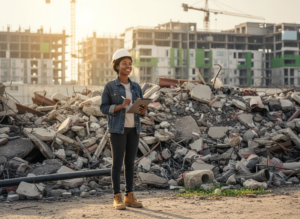
Nigeria is experiencing rapid urbanisation, with cities expanding faster than infrastructure. Rapid and often unplanned urbanisation exacerbates construction and demolition waste (CDW) challenges; With the construction sector contributing to high resource consumption (sand, gravel, stone, water), carbon emissions (40%), and waste generation (25-30%) in Nigeria. This development is worsened by the intensive activities of workers without adequate training in the construction sector. It underscores the increasing need for professionals who can innovate in recycling construction materials, designing for deconstruction, and waste reduction. To address this, GROW will develop a dual-language (English Portuguese) training programme for construction workers and unemployed youth in Nigeria, equipping them with the necessary skills to manage CDW sustainably, while also guaranteeing social and gender inclusion.

Mozambique

Construction and demolition waste (CDW) in Mozambique faces several challenges that limit effective management and sustainable reuse. Formal systems for managing CDW are underdeveloped, with weak waste collection infrastructure and limited recycling facilities, meaning much debris from building and demolition activities can accumulate in streets or informal dumps rather than being processed properly. Municipal waste management structures struggle with low service coverage, insufficient technical capacity, and poor enforcement of regulations to control disposal and encourage recovery of materials like concrete, wood, and metal. These gaps contribute to environmental and public health risks, as well as missed opportunities for resource recovery and economic benefit from reuse of construction materials. To bridge the gap, GROW will engage construction firms in Mozambique, (both large and small), in discussions on skill gaps, internships, and job opportunities, ensuring the program is demand-driven. By promoting international collaboration and fostering sustainable construction practices, GROW aims to build a skilled workforce, drive decent job creation, and reduce the environmental impact of the construction industry across SSA.

Objectives

By addressing key challenges as effective construction waste management in Sub-Saharan Africa, GROW aims at intervening in the construction industry, through comprehensive skills development. The overarching objectives can be summarised as follows:

01

skills
and boosting

Providing skills and boosting motivation for VET managers and VET teachers

GROW will boost motivation providing a concrete opportunity for professional growth, engaging teachers and managers in an international programme with African and European mentors, giving the opportunity for peer-to-peer exchange. GROW will increase environmental and innovation awareness through a multidisciplinary ToT programme and capitalisation programme

02

public-private partnerships

Fostering public-private partnerships (PPP) and cross border collaborations

Foreseeing an active role of education institutions like VETs, to improve the construction sector.

03

social mobility and employment opportunities

Providing social mobility and employment opportunities for the VET learners

Engaging vulnerable unemployed youth and construction workers (upskilling/continuous education) in the VET programme

04

Circular Economy

Promoting Circular Economy micro entrepreneurship as an income source

For community members, particularly women, and reduce poverty and social vulnerability

05

values and awareness

Broadening local values and awareness on waste

(Why it matters and how it can be managed) through the active participation and action of the VET schools involved

06

environmental impact

Reducing the overall environmental impact of the booming construction sector

(Why it matters and how it can be managed) through the active participation and action of the VET schools involved

07

healthy communities, sustainable livelihoods

Coupling a holistic vision

For healthy communities, sustainable livelihoods, and a healthy environment, fostering multi stakeholders’ partnerships (schools, local authorities, private industry).