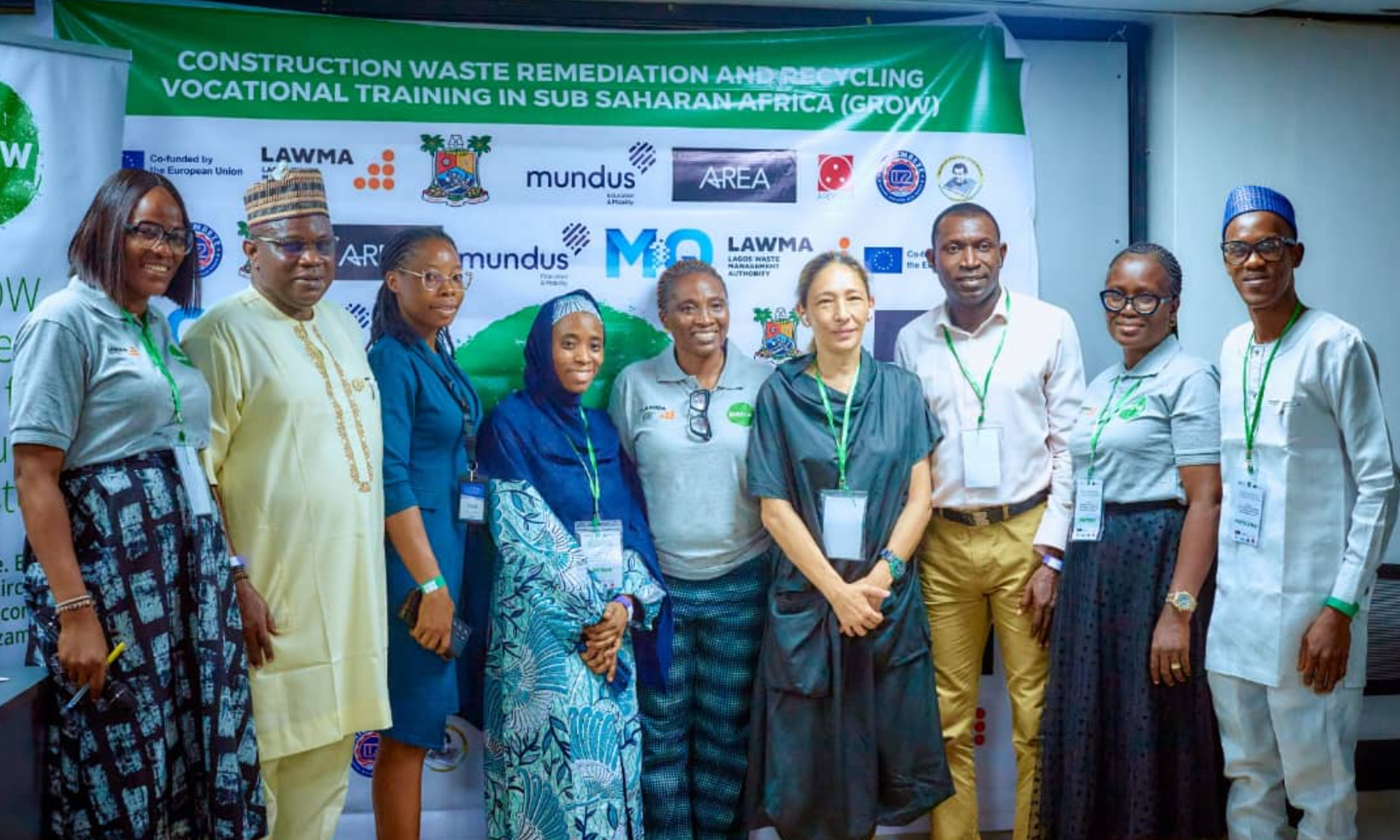
Coordinated by Lagos Waste Management Authority (LAWMA), on 14th April, 2026, stakeholders across Nigeria’s construction, waste management sector, and Technical and Vocational Education and Training (TVET) schools convened in Lagos for a stakeholder workshop under the GROW Project.
The workshop, moderated by Elizabeth Ademola, LAWMA Circular Economy and Sustainabilty Expert, aimed to gather insights to support the development of responsive training approaches in Construction and Demolition Waste (CDW) management, while strengthening youth competencies for participation in the circular economy to promote digital green and sustainable development.
Isabel Gonçalves from Minimos Quadrados MQ, the project coordinator in her goodwill message presented the project’s objectives, noting that it seeks to upskill youth in Nigeria and Mozambique through comprehensive training programmes focused on Construction and Demolition Waste management. She stressed that strengthening green skills among young people will significantly expand employment opportunities and support the transition toward circular economy practices.
Mr. Kunle Adebinyi, Executive Director of LAWMA, open the workshop by highlighting the persistent challenges associated with waste segregation in Nigeria, particularly at the construction site level. He emphasised the importance of enhanced multi-stakeholder collaboration to strengthen waste management systems and promote sustainable environmental practices nationwide.
Further technical insights were provided by Kemi Oyewo, Regional Manager (Sanitation), West Lagos, and Jirinsola Olaleye, Head of Circular Economy LAWMA, who outlined the structure of Nigeria’s waste value chain and identified priority strategies for strengthening waste segregation systems and improving operational efficiency across the sector.
Margherita Trestini from AREA, a GROW Project partner in Italy, shared perspectives on the opportunities available to Nigerian youth within the waste management value chain. Drawing on experiences from the GreenVETAfrica Project, she highlighted how capacity-building initiatives can enhance employability while strengthening innovation across the sector.
A representative of Lafarge Nigeria, Temitope and Adikola from SUACASA presented ways to converting construction waste into new building materials, demonstrating pathways for integrating circular economy solutions within Nigeria’s construction industry.
The President of the Association of Waste Managers of Nigeria, Mr. Adebola, in his speech, reaffirmed the Association’s commitment to the project, describing the initiative as part of the broader national “war against waste.” He underscored that institutional collaboration, supported by research, innovation, and technical expertise, is essential to achieving sustainable outcomes in the waste management sector.
Representing APODISSI, Zainab Suleiman, Communication and Dissemination Specialist for the project, expressed confidence in the consortium’s collective expertise, noting that with the strong leadership of LAWMA and the contributions of European partners, Nigeria is well positioned to advance effective construction waste management through the training programmes to be developed under the GROW Project.
Honey Treat Trade Academy Lagos reported that it has trained over 7,000 youths across various National Skills Qualification (NSQ)-certified TVET programmes, according to Kate Nyong, although training in construction waste management remains an emerging priority area. Contributing to the discussion, Engineer Yusuf Ibrahim of the Industrial Skills Training Center Kano arm of Industrial Training Fund (ITF) emphasised the need for stronger sensitisation on demolition waste management practices and increased government involvement to support monitoring and enforcement mechanisms.
After gathering input from all stakeholders, three breakout sessions were organised at the end of the workshop. Participants were grouped into industry, regulatory institutions, and waste workers representatives. These sessions enabled the identification of underrepresented barriers and challenges contributing to the ineffective management of Construction and Demolition Waste (CDW) in Nigeria, as well as important pathways for addressing them. The discussions also mapped the construction waste generation to recycling value chain within the Nigerian context. The outcomes provided crucial information that will direct the development of the GROW Project’s framework for strengthening CDW management practices in Nigeria
In closing remarks, Olarere reiterated that the primary objective of the workshop was to deepen stakeholders’ understanding of the GROW Project while strengthening collaboration among key actors to ensure effective implementation and long-term impact across Nigeria’s construction and waste management ecosystem.