
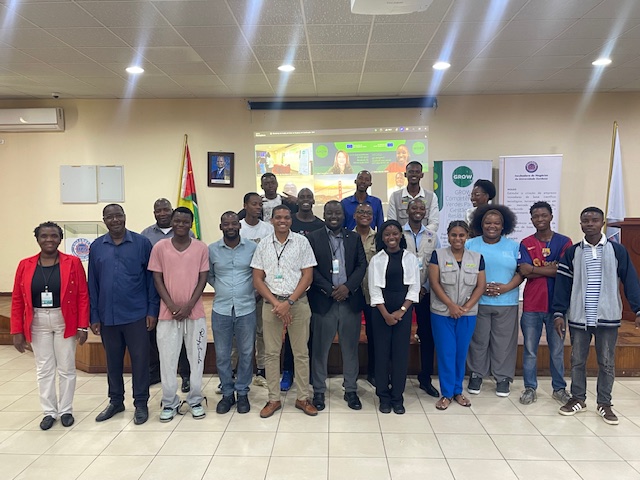
On 24 April 2026, Zambeze University’s Business Incubator brought together academics, government officials, industry practitioners, students, and environmental organisations for a hybrid workshop on “Construction Waste Value Chain and the Assessment of Technical Skills Needs” in Beira, Mozambique.
The workshop created an opportunity for stakeholders from different sectors to exchange perspectives on construction waste management challenges and identify priorities for future action.
Isabel Gonçalves from Mínimos Quadrados (MQ), the GROW project coordinator, opened the event by outlining the initiative’s objectives: to deliver practical, skills-based solutions to the rapidly growing volumes of construction and demolition waste across Mozambique and Nigeria. Central to this vision is a bilingual training programme designed to cultivate green skills and enhance employability in the sector, creating a direct response to labour market demands that traditional curricula have yet to meet.
The academic programme was anchored by presentations from Dr. Belchior José Manuel and Eng. Eulávio Romão Bernardo (MSc) of Zambeze University, who delivered a rigorous analysis of the construction and demolition waste value chain and facilitated an engaged dialogue with participants. Their session encouraged discussion on the practical challenges and opportunities related to construction and demolition waste management in Mozambique.
Eng. Feleciano Januário, Coordinator of the Business Incubator, led a dynamic brainstorming exercise to map the value chain and identify critical technical skills gaps. The session drew substantive contributions from participants across sectors, with Mr. Celso Mungoi of Repensar Mozambique highlighted the importance of modular and disassemblable construction techniques, as well as the use of recycled materials, as practical approaches to reducing waste from the design stage onwards. The main findings included:
- The urgent need for mandatory waste separation on construction sites, backed by enforceable regulation and clear compliance mechanisms.
- Persistent challenges in the safe treatment of hazardous materials, including paints, glass, and chemical compounds requiring specialist handling.
- The circular economy as a viable and necessary alternative to the prevailing linear model, repositioning waste as a productive resource.
- Technical and vocational training as a strategic lever for sustainable development and long-term sectoral transformation.
- Significant untapped potential for job creation and entrepreneurship within the construction recycling and waste management sector.
Participants converged on three priority areas: the strengthening of the legislative and regulatory framework governing construction waste; investment in adequate treatment and processing infrastructure; and the expansion of inclusive, market-oriented technical training programmes accessible to a broad cross section of the workforce.
Closing the workshop, stakeholders from across the public and private sectors reaffirmed their collective commitment to supporting Mozambique’s transition to a circular economy, pledging continued investment in capacity building and the development of a robust, sustainable construction waste value chain.